
A guide to equine dental equipment
- kirstenmbinnie
- Mar 30
- 5 min read
By Alice Hughes
Alice Hughes owns and runs Alice Hughes Veterinary Equine Dental Care. She holds the BVMS CertAVP(ED), PgCert BAEDT and MRCVS qualifications and is an Advanced Practitioner in Equine Veterinary Dentistry.

EQUINE dentistry has evolved significantly over the years, with modern equipment allowing for safer, more precise and more comfortable treatment for the horse. Below is an overview of the key tools I commonly use in routine dental procedures.
History of dental equipment
Traditionally, equine dental work relied heavily on manual tools and physical restraint. Early rasps were simple hand-held instruments, and examinations were often limited by poor visibility. Advances in technology – particularly the introduction of sedation, electric instruments and endoscopic imaging – have transformed equine dentistry into a highly precise and welfare-focused discipline.

An oral examination taking place in the 15th century – image taken from a very early veterinary manual 'Proprytees and Medicynes of hors'. Thankfully equipment has evolved since then!
Sedation
I always use sedation in my equine dental care. It allows the horse to remain calm and comfortable while enabling a thorough examination and treatment. Sedation also improves safety for both the horse and myself, making it possible to carry out more detailed and less stressful procedures.

There are many sedation options depending on the patient and procedure. I commonly use a combination of two different drugs injected into the jugular vein which gives a good level of calmness whilst the horse is still standing and often lasts for around an hour. Oral sedations (such as Domosedan gel) are also available and great for patients who do not like injections.
PPE (Personal Protective Equipment)
Appropriate PPE is essential for the dentist’s safety. This typically includes gloves and, sometimes, protective eyewear, ear defenders and face masks when using powered equipment that may generate debris or fluid spray.
Gag/speculum
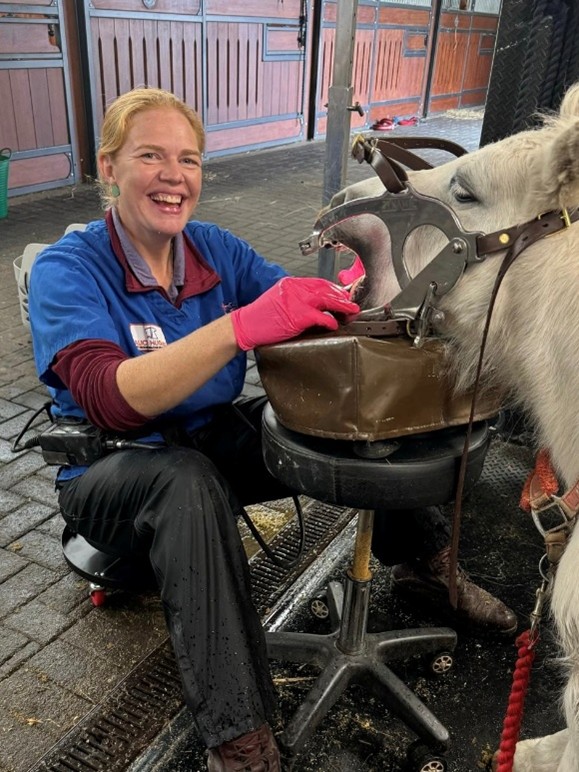
A gag, or speculum, (below left being used on a Shetland) is used to safely hold the horse’s mouth open during examination and treatment. Modern designs are highly adjustable and padded to minimise pressure and improve comfort, while allowing excellent access to all areas of the oral cavity. Smaller versions are available for smaller patients, which further improves comfort.

Water flushing
Water flushing systems (below right) are used to rinse the mouth, removing feed material and debris. This improves visibility and allows for a more accurate assessment of the teeth and soft tissues. A large manual syringe works well, but I more frequently use a battery-powered flusher with different attachments – ideal for cleaning hard-to-reach areas and removing trapped food between teeth.

Light source
Good illumination is critical in equine dentistry. High-powered head torches or mounted LED lights that magnetically attach to the mouth gag provide consistent, focused lighting enabling detailed examination of the teeth, gums and oral structures.
Head stand
A head stand supports the horse’s head during procedures, reducing strain on both the horse and the practitioner. Proper positioning is essential for precision work and helps maintain stability throughout the procedure. A sling halter to suspend the horse’s head can also be used; however, a strong overhead beam is required.
Seats
Adjustable seating allows me to work at the correct height and angle, improving ergonomics and reducing fatigue during longer procedures. This is particularly important when performing detailed dental work. I even carry a very small stool for our mini friends!
Mirror, picks and probes
Dental mirrors, picks and probes are essential diagnostic tools. They allow close inspection of tooth surfaces, detection of abnormalities such as fractures or periodontal disease, and assessment of gum health.
Oroscope
An oroscope (dental endoscope) provides a magnified, illuminated view of the oral cavity on a screen. This advanced tool allows for detailed examination, improved diagnosis and has the ability to show findings directly to horse owners, as well as record them for future comparison.

Electric rasps
Electric rasps have become a cornerstone of modern equine dentistry. They allow for efficient and precise reduction of sharp enamel points and correction of dental imbalances, while minimising physical effort and procedure time. A wide variety of interchangeable heads are available to access all areas of different-sized horses’ mouths and perform specific tasks – I routinely use four different ones.
Manual rasps
Despite technological advances, manual rasps remain valuable tools. They offer excellent tactile feedback and control and are often used for fine finishing work or accessing tight areas in smaller horses. I routinely use a small hand rasp for canine teeth.
Extraction equipment
Specialised extraction instruments are used for the removal of diseased or damaged teeth, and routinely for wolf teeth. These tools are designed to provide controlled force and precision, often used in conjunction with imaging, pain relief, local anaesthetic and sedation to ensure a safe and effective procedure.
The lightness and accuracy of these tools have improved significantly over recent decades, and new developments continue to emerge. As research and knowledge in advanced equine dentistry evolve, so too does the technology available to treat these patients.

Equipment maintenance and hygiene
All dental equipment must be carefully maintained to ensure it remains safe, effective and reliable. Instruments should be thoroughly cleaned and disinfected between yards to reduce the risk of cross-contamination and the spread of infection.
Mechanical and powered equipment should be regularly checked, with servicing carried out at least annually. Well-maintained tools not only perform better but also improve safety for both horse and practitioner. Attention to cleanliness, sharpness and function is a fundamental part of delivering high-quality dental care.
Modern equine dental equipment plays a vital role in maintaining oral health, improving performance and enhancing overall welfare. Regular dental examinations using appropriate tools help ensure problems are identified early and managed effectively.
To book your horse's dental check, contact Alice at https://www.dentalequinevet.com
Or email alice@dentalequinevet.com


Comments